
When elected on July 18 -- which is almost a certainty, given the NDA's numbers in the electoral college -- Droupadi Murmu will be the first President born after Independence.

He also accused the Congress of delaying a solution to the Kashmir issue for seven decades.
'Anyone who heard her sing was left with a lump in the throat.'

The commission had rejected the theory that it was a spontaneous act by karsevaks whereas the CBI court has ruled that there was no evidence that demolition was a conspiracy.
'There is no point in just saying, 'hum wapas bhej denge (we will send Kashmiri Pandits back)'.'
Aakar Patel looks forward to Prime Minister Modi's speech at the bhoomi pujan for the Ram temple in Ayodhya next week. It will be entertaining and stirring, predicts Aakar, and make lots of promises that he most likely won't be able to keep.

Controlled communal tension is useful in ensuring continued Muslim support. Fear of the BJP is a requirement for both, the Congress and the Samajwadi Party, to keep their Muslim vote bank in line, says Saeed Naqvi.
Addressing a rally in Karkardooma in east Delhi, Modi alleged that the AAP and the Congress were provoking people and misinforming them. They were keeping the Constitution and tricolour in the forefront, but the aim was to 'divert attention from the real conspiracy', Modi said ahead of the Delhi elections on February 8.

'That would be very bad for them and suicidal for both the Gandhis and the Congress party.'
Syed Firdaus Ashraf/Rediff.com tracks Prime Minister Narendra Damodardas Modi's project-launching spree with just about three months to go for the assembly election in India's most populous state.

From the Aadhaar verdict to #MeToo's arrival in the country to the entry into the Sabarimala temple -- India had a newsworthy 2018. As we step into 2019, these are the top moments from the year gone by.
'The BJP's solo aim in Mumbai and Maharashtra is to finish off the Shiv Sena and Sharad Pawar's NCP.'

The focus shifts almost immediately from celebrations to the challenges faced by the man who powered his party to 303 seats in the Lok Sabha.

Known as an astute strategist whose non-political interests range from playing chess and watching cricket to stage performances and listening to classical music, 54-year-old Shah is often hailed as the BJP's most successful president for crafting its way to power states after states.

In the midst of a raging row over the conversions in Agra by Hindutva outfits, the Bharatiya Janata Party chief Amit Shah on Friday favoured a strong law to stop forcible conversions.

'The fact that a rural Kashmiri boy was brainwashed into killing himself and others means there is an active programme that exists which does such recruiting and there will potentially be other such individuals out there,' warns Aakar Patel.

Narendra Modi has a once in a lifetime chance to change and take the RSS-BJP-VHP to a new level. Varanasi is the right place to turn the page on saffron history. By surrendering to the spirit of mystical Varanasi, Modi and his party can change the trajectory of their political journey.
The real brilliance of this RSS campaign, therefore, lies in building a dominant power base with, and for, a mostly non-RSS leadership. That is why the rise of the BJP in Assam is their stand-out victory, says Shekhar Gupta.

Behind sprinter Dutee Chand's rise is a hidden journey filled with pain and hardship.
Like Nehru, Modi is loathe to touch the public sector. His policy towards Israel leans towards 'non-alignment'. You can find other similarities: frequent public speeches, personalised leadership, total control over foreign and strategic policies, even stylised dressing, says Shekhar Gupta.
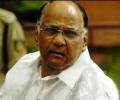
Taking a dig at Bharatiya Janata Party's prime ministerial candidate, Nationalist Congress Party chief Sharad Pawar said he feared that there were grim indicators of Indian democracy being concentrated in one person's hand after the marginalisation of party veterans like LK Advani and Murli Manohar Joshi.
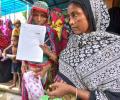
'Bangladeshi Muslims want to increase their population in India.' 'They have made colonies in India.' 'Rohingyas are doing the same.' 'This has to stop.'
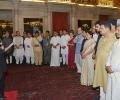
'The reason why Prime Minister Narendra Modi should have attended the President's iftar was not merely to break a fast with the faithful, but more importantly to broker an understanding with India's second largest set of citizens,' says Shehzad Poonawalla.

'At the very end of his speech, he dealt with the 'small problems' of Indian workers. But these measures did not seem to satisfy those who had expected the prime minister to find solutions for their problems. That the prime minister generally focused on broad policy issues and not on matters of detail left them bewildered,' says Ambassador T P Sreenivasan.

Though the list of superstitious beliefs is long, often dissolving distinctions of class, caste, religion and education, Karnataka's anti-superstition bill is seen as a big step ahead.
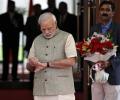
'Non Resident Indians know that India's problems are the combination of many factors over the centuries, including foreign rule, lack of resources and the ever-growing population, among other things. Yet, India has achieved many things and even looks at Mars as a neighbour.'

Atal Bihari Vajpayee would seek to placate the hawks in the RSS by stating that the writing of history should not be one-sided. At the same time, he would project a moderate 'Nehruvian' image of himself as the archetypal liberal politician who would strive to attain a balance between conflicting viewpoints. A fascinating profile of the former prime minister and Bharat Ratna by Paranjoy Guha Thakurta and Shankar Raghuraman.

Attired in his trademark half sleeves kurta and sporting a Rajasthani turban, Prime Minister Narendra Modi devoted a bulk of his 90-minute address on the occasion of the 70th Independence Day to presenting in effect a report card of his government's work particularly in boosting economic growth, ease of doing business and welfare schemes for the poor and farmers.
